It’s another roguelike deckbuilder…but wait! Before you close that tab Fogpiercer does have some new and interesting ideas up it’s sleeves for the now well-established genre. If you abhor roguelike deckbuilders this one won’t convert you, but it’s an interesting lesson in how being different isn’t always better.
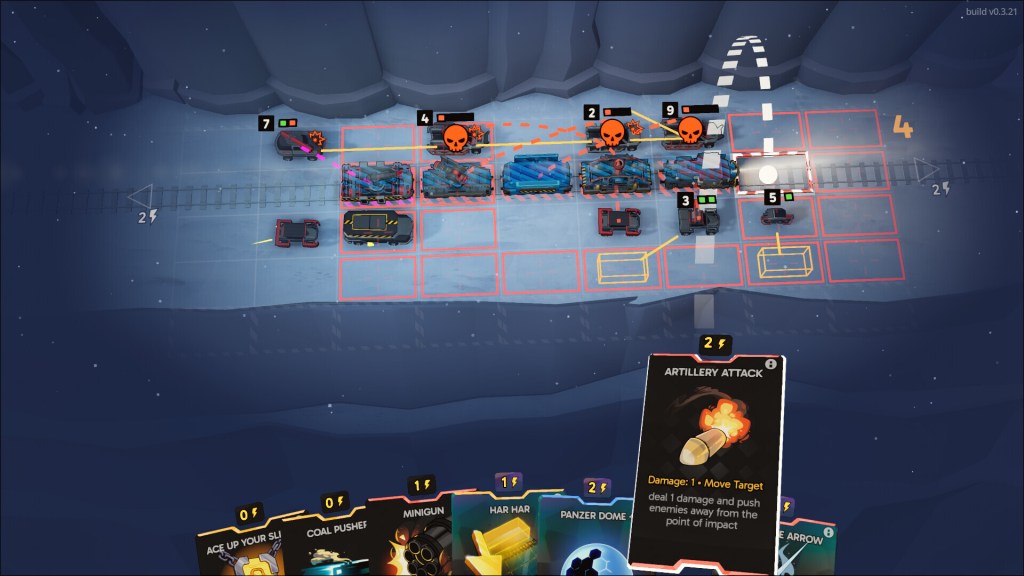
On the face of it, Fogpiercer is a game about getting a train through a foggy world and surviving raids by cars, bikes and more as you trundle along. Because you’re a train, you only have the option to increase or decrease speed while the attacks around you have the freedom to move left, right, up and down the battle grid. This creates an interesting asymetric combat map that unfortunately doesn’t get maximised to its full potential.
Fogpiercer at a glance
Reasons to play
- Customisable runs with choice over characters, 3 carriages and multiple upgrade paths
- A cel-shaded artstyle of an uncommon setting, with music matched to the motion of the train in the same way Monster Train achieved
- A dedicated horn button that changes depending on which engine you have pulling your train
Reasons to skip
- For a deckbuilder, there’s very little building. It plays more like a slightly weird Into the Breach than a slightly weird Slay the Spire
- Impossible fights happen, unlike Into the Breach. The enemy AI is just not quite thorough enough to ensure you can always have a decent (or at least survivable) play in hand
- Progression can feel slow unless you go in a specific order through the carriages, and characters are locked to a specific linear path
Most Unique Feature
Fogpiercer’s most unique feature is unfortunately also the reason it feels so restrictive to play: The train and carriage system. This system adds card packs to your deck for every carriage you take, but that in turn restricts all the cards you pull for the rest of the run.
Satisfying combos…that you repeat ad infinitum
The core premise of Fogpiercer is sound, and in fact intriguing. The idea of swapping out carriages and carefully speeding up or slowing down to have the right attacks in range of enemies who flit about the train like annoying flies is an appealing one. This is doubled by the fact that destroyed vehicles dramatically surge backwards (Or, I suppose, they stop while everything else keeps moving) dealing damage to anything immediately behind them in that lane.
Reducing enemy HP and then triggering a chain of crashes on the mountainside is satisfying and rewards tactical thinking, no doubt, but that’s all the game does with the idea. There’s so little expansion into “but what if I do this?” buildcrafting that the deckbuilding feels at best okay and at worst actually detrimental to the game itself.
See, in Into the Breach you command a squad of bots against bugs, but all the encounters and attacks play out like a puzzle game more than a deckbuilder. Indeed, you don’t have a deck in Into the Breach. So why am I bringing it up?
4 + Card Pools Per Run Actually Restricts Customisation
Fogpiercer has Into the Breach style puzzle combat, but with deckbuilidng on top. These systems are completely at-odds with each other. In a deckbuilder I want to experiment, go “oops all [card name]“, mix and match playstyles by adding individual cards of each…I want to, strangely, BUILD a DECK.
Fogpiercer’s puzzle combat doesn’t allow that. Not only from the tactical standpoint that if you tried to do those sorts of decks you’d straight up lose the run, but also from an even more strict stance: the game doesn’t let you.
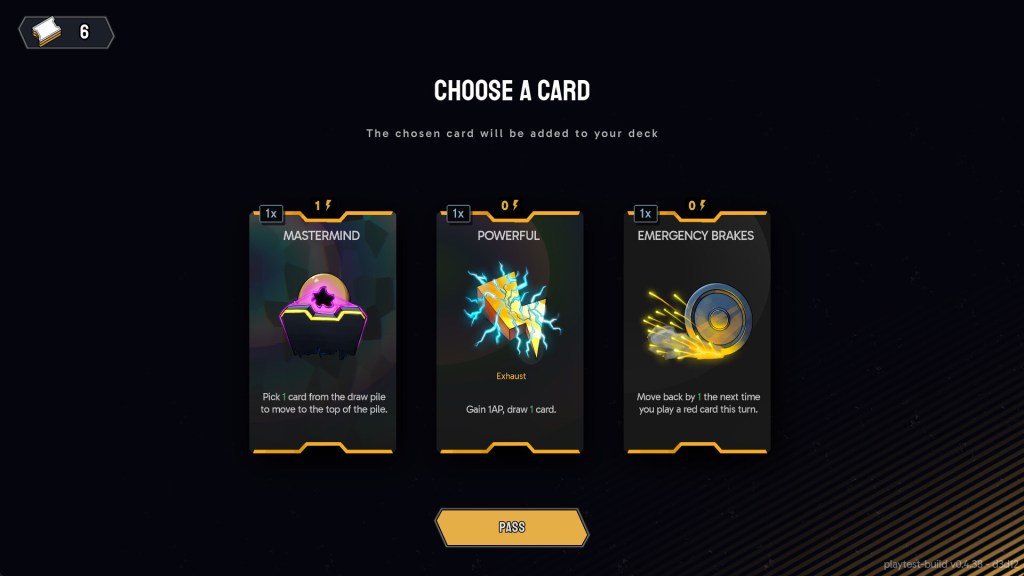
Unlike most deckbuilders, the cards you draw are restricted to 4 – 5 pools of just 4 – 5 cards each:
- Your character choice gives you a few power cards that you can use only once every few fights.
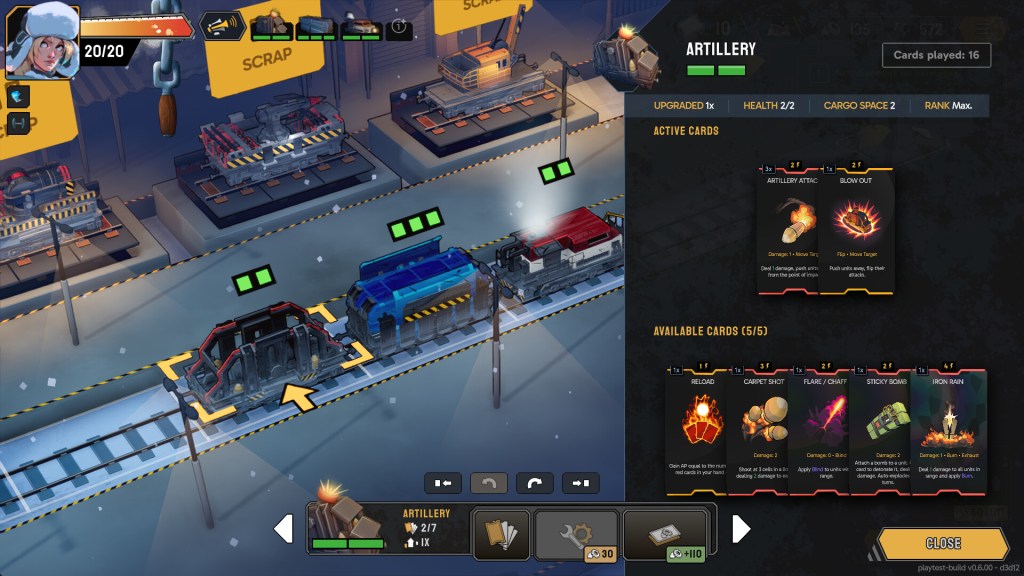
- Your carriages each give you a few cards based on what carriage they are. The minigun comes with red attack cards, the shield generator with blue defend cards, etc.
- Your engine choice gives you a few yellow movement and utility cards, with some engines also dipping into attack or defence.
Once these carriages are chosen and attached, that’s that. You basically know what you’re getting. This is great for making very specific decks that rely on repeated strategies, but kills any other brand of deckbuilding.
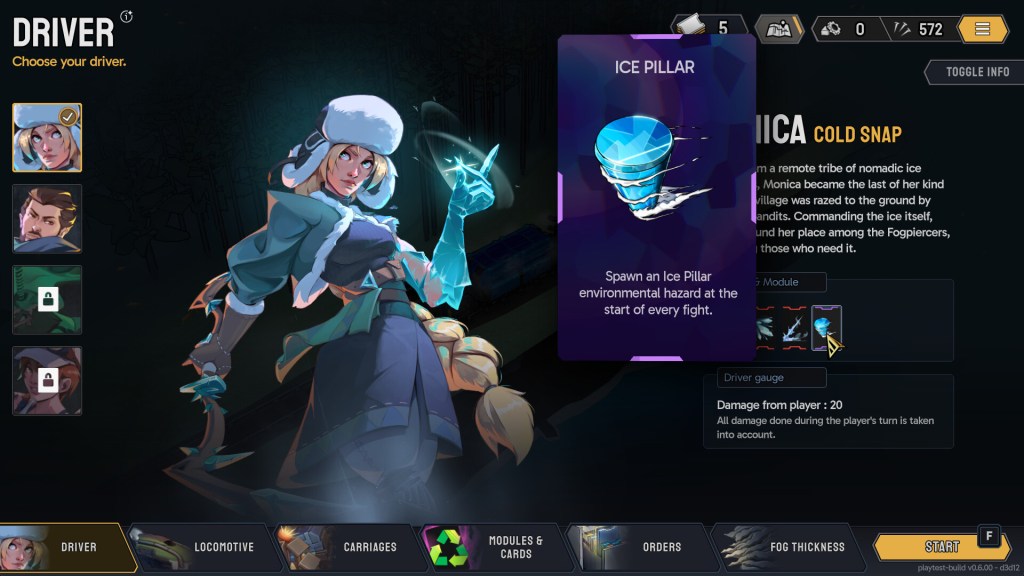
In fact, it’s not really deckbuilding at all. it’s more like you’re building the theme of the deck and the cards are then guaranteed after that choice. It’s sort of like choosing “I’ll play a block stacking deck this run” in Slay the Spire, and then instead of having to actually work towards that goal and earn the cards (or transform into them or buy them) the game just gives you the cards you need because you chose them at the start.
This is why Fogpiercer isn’t quite as tactical and puzzle-based as Into the Breach but also can’t be as free-form and deckbuilder-based as Slay the Spire. It tries to be its own thing, which is admirable, but ultimately fails to really create an engaging loop. It might be original, but originality isn’t everything.
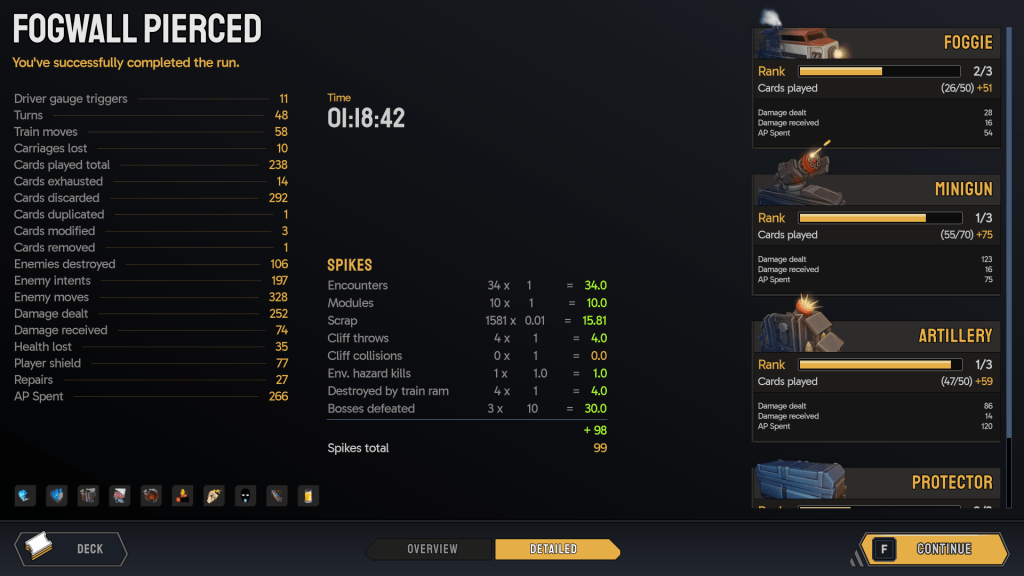
Play a run, honk the horn, see how you feel
Ultimately it’s worth dropping in to see the cel-shaded world, hear the music pick up and watch cars spiral into each other at the end of a great card combo. After that, though, I can’t say the appeal will hold for long. Being able to manually honk the engine’s horn genuinely added about 3 hours to my playtime, since runs can be quite long, but maybe you are more resistant to the charms of irreverent horn noises on-command…




Leave a Reply