Pragmata is the next big thing from Capcom, a company that had a few years of banger-after-banger and is trying its luck with something a bit less safe, a bit more experimental, a bit unique.
Or is it?
See, while I don’t actually think I played Pragmata on the PS2, I did play a demo for a 2003 release that is the only other place I have ever seen the hacking-combat minigame from Pragmata before, and it’s uncanny.
What’s Unique About Pragmata to Begin With?
The feature I’m referring to is the hacking-combat hybrid system. In Pragmata you control budget Isaac Clarke who uses an asortment of firearms, but you also have control over your AI helper, Diana. Diana can hack enemies in real-time to expose weak points, interupt attacks and more.
You don’t just press the “Hack” button and open fire, though. You actually have to manually play a hacking minigame to perform the hack, while still maintaining suppressive fire, walking back, avoiding attacks and keeping aware of other enemies in real-time.
This hacking minigame takes the form of a grid. On the grid is Diana’s starting location and the final node she has to reach to complete the hack. You have to navigate the grid and avoid defensive code, pickup hacking bonuses and hit the final node in time to trigger all the effects you passed through on the way.
Sounds pretty unique…
Alter Echo on the PS2 My Beloved
15 Years Ago
I sat on the floor infront of the sofa in the living room to boot up an old demo disk. Not even just old by today’s standards, but old by the standards of the time. When I was younger I had a habit of replaying games and demo disks over and over, as I’m sure countless other kids were doing across the nation.
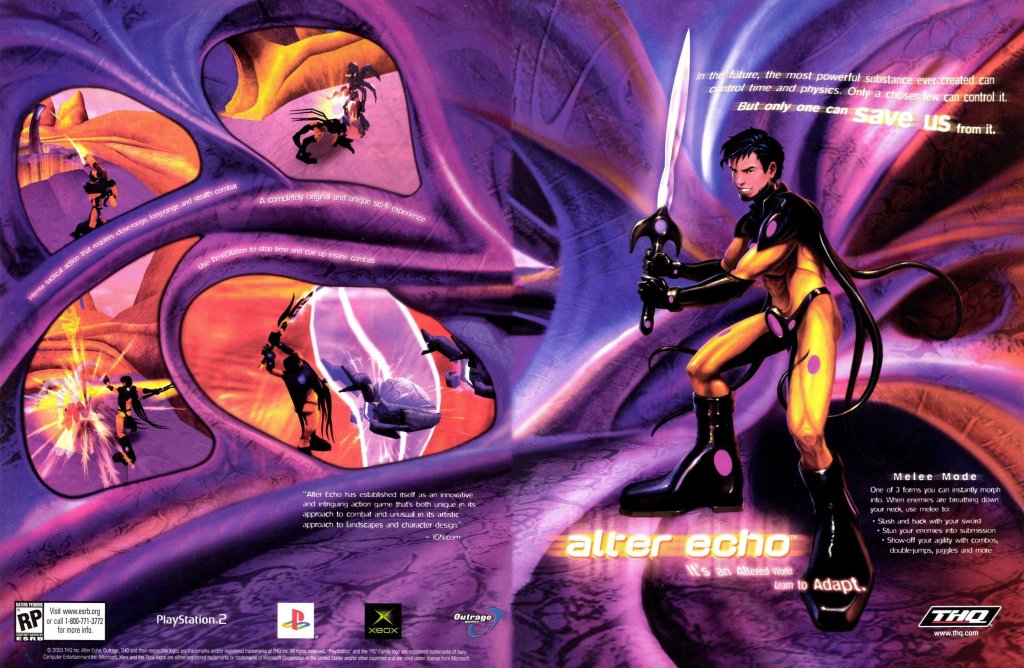
One demo in particular was for Alter Echo, a 3rd-person action game where you’d fight real-time DMC-style battles before triggering a super attack which hacked enemies around you. Once you triggered this attack, the pressure was on…
You were thrust into a hacking minigame that takes place on a huge grid, but the grid was vaguely emblematic of the current enemy layout. Enemies infront of you were likely to be close the the middle while distant enemies were on the edges of the grid. You had to move your selector from space to space with the goal, ideally, to hit every enemy before finishing. There were bonuses and extenders too, which would activate if you successfully finished the hack after picking them up.
This is sounding familiar…
Anyway, the main thing that kept me coming back and replaying over and over was the absolute perfection with which you had to play to simultaneously hit all the enemies in a room.
Not only are you having to find them all on the grid, but your time is limited.
Not only is your time limited, but you have to move your selector on the beat (Did I mention the hacking minigame was also a rythm game?) which would gradually increase in speed the longer you stayed.
Not only did the beat gradually increase in speed, but one wrong move into an obstacle or to a space you’d already been (Oh right, it was also like Snake) and the whole hack would end prematurely.
I spent hours replaying the demo disk level until I could reliably one-shot every room with a perfectly executed hack. Still, to this day, I have never played the full game…
I Couldn’t Find a Dev Connection
With how similar the hacking mechanics in Pragmata and Alter Echo are, all these years apart, I was curious if the devs were the same. All it takes is one dev to pass from company to company and revive the idea. Alas, the Alter Echo team seem to have been eaten up by Embracer and Gearbox, rather than the Capcom route. Dang.
If Pragmata can pull of a mechanic that whack, that insane and that ridiculously satisfying then I can see it being a breakout hit.
As for me? A new AAA game is a little dear for my tastes so, maybe I’ll did out a copy of Alter Echo…


 Frame Imperfect | Gaming
Leave a comment