

Like a Dragon: Infinite Wealth is a gargantuan game, and spoils you with brilliant moments throughout. But, the longer and more complex a game and it’s characters, the easier it becomes to fumble the ending.
Mass Effect 3 is the classic example, a game which takes the entire series into account only to offer you a choice of RGB at the final hurdle. It’s an example of how even a series as reactive and impressive as ME has to end, and has to eventually come down to *something* definitive.
Just the same, Infinite Wealth had to have an ending, and were never going to address everything from the 500+ hour series which this is a culmination of.
So, Infinite Wealth doesn’t even try.
Even Yakuza 0, a game with 2-5 “main” cast, had an ending sequence of cutscenes 56 minutes long. LaD Infinite Wealth’s finale is just 30 minutes and covers a “main” cast of 8-12. While time isn’t everything, it is a good way to visualise just how much the Infinite Wealth ending had to omit.
So, rather than trying to close all the loose ends and give every character due diligence, the ending instead spends the majority of it’s time on symbolism.
Symbolism isn’t necessarily something the Yakuza series is a stranger to. However, in previous titles that symbolism and analogical storytelling was always done in the context of *things* happening. Be it characters dying, fights going sideways, dramatic decisions by a protagonist, or just a series of updates on the effects of the game’s events.
In LaD the symbolism is really hammered home and doesn’t leave room for much else, which at first left me personally feeling the ending was too empty.
What the ending does do, it does beautifully, but it just might not do enough for long-time fans.
Spoilers for LaD Infinite Wealth Ahead
What symbolism exists in the LaD Infinite Wealth ending?
LaD Infinite Wealth is a game about paying for crimes, being punished for “sins”. There’s a lot to be said for this throughout the entire game, but focussing on the ending we can see a clear culmination of this theme.
The Final Boss Fight Switcheroo
Kiryu, a man who was made terminally ill from involvement with nuclear material (And, let’s be real, a lifetime of smoking and drinking daily), fights the final boss who is Ichiban’s Half-Brother.
Ichiban, a man who has been chasing a family member and trying to honour his father for the entire game, fights the final boss who is responsible for handling nuclear material.
They fight each other’s bosses.
Kiryu’s story aligns with Bryce in more ways than one, with the mirror between Haruka and Lani providing an additional thread of fate there on top of the whole nuclear schtick.
Ichiban’s story aligns with Ebina in a similar way, a man who is related to Ichiban after Ichiban spends so much effort tracking his family. Not to mention, Ichiban’s irrepressible faith in humanity is a huge theme in the game, and facing an Arakawa who is committing genocide would maybe have been too far even for him.
At first I was straight up confused.
Why would Kiryu, the one affected most by power-hungry nuclear energy advocates, not be the one fighting Bryce in a literal nuclear dumping ground?
Why would Ichiban, the one who understood and modelled Arakawa more than anyone, not be the one fighting Ebina to show how two characters, from the same “source”, turned out so differently?
The answer is the theme of “sin”. Kiryu and Ichiban shoulder each other’s burdens, because both know that these are issues that transcend the individual.
Ichiban will use that irrepressible hope of his to spare Kiryu facing possibly his most hateful villain – Bryce.
Kiryu will use his legendary status to represent all Yakuza, to take the issue away from Ichiban and Arakawa, and instead frame it as a fundamental issue with the Yakuza as a whole, all of whom Kiryu pleads for in the end.
In this way, the two villains are really made for the each protagonist, but that’s exactly why they are fought by the other one. It’s just one way that the “dying for another’s sins” theme is shown.
The Road to Calvary
After the bosses lie defeated and Kiryu is whisked off to hospital, we experience the final part of the jounrey.
Ichiban tracks down Eiji Mitamura, someone who went a little “Batman villain” for a few moments as he plays out a grand scheme of revenge on the Yakuza.
Eiji is responsible for ruining (or aiding in the ruination of) the lives of countless ex-Yakuza, stopping them from returning to society and in turn pushing them in to Ebina’s open arms. Arms which Kiryu is throwing himself into in the hopes of stopping the slaughter…
So, Eiji isn’t exactly “forgivable”. There’s a history of hatred there, and he has his reasons for going against the Yakuza, but let’s not forget he was a member and leader of Bleach Japan, a group that uses the most underhanded and hateful tactics in the book to enforce a twisted sort of moral objectivity on Japan in the previous game.
The point is, Eiji is both extremely villainous but also a perfect encapsulation of the Yakuza’s failings. Eiji is a product of the Yakuza’s “sin” in the same way Ebina is an equal to it.
This leads us to Ichiban meeting Eiji, at the end of the game.
Ichiban holds out a hand, calls Eiji a friend, and has no time for the stuttering questions of Eiji.
To Ichiban, the world is obvious.
Eiji is forgiven, because Ichi will always forgive them. And Eiji is innocent, because Ichi will always take the blame.
After we see Kiryu ball over and cry (something which only happened in Yakuza 3 to this extent), pleading for the “sin” of the Yakuza to be erased rather than punished by slaughter, Ichiban is there to enact that erasure. He is there to be what he thinks the Yakuza could, or should, be.
Ichiban picks up Eiji, and begins his walk to Tokyo PD.
The symbolism here is impossible to miss. We have a protagonist carrying the weight of the Yakuza’s sin on his back, making a journey flanked by the public who are resentful. This mirrors Jesus’ Procession to Calvary in a way that even as an atheist is unavoidable.

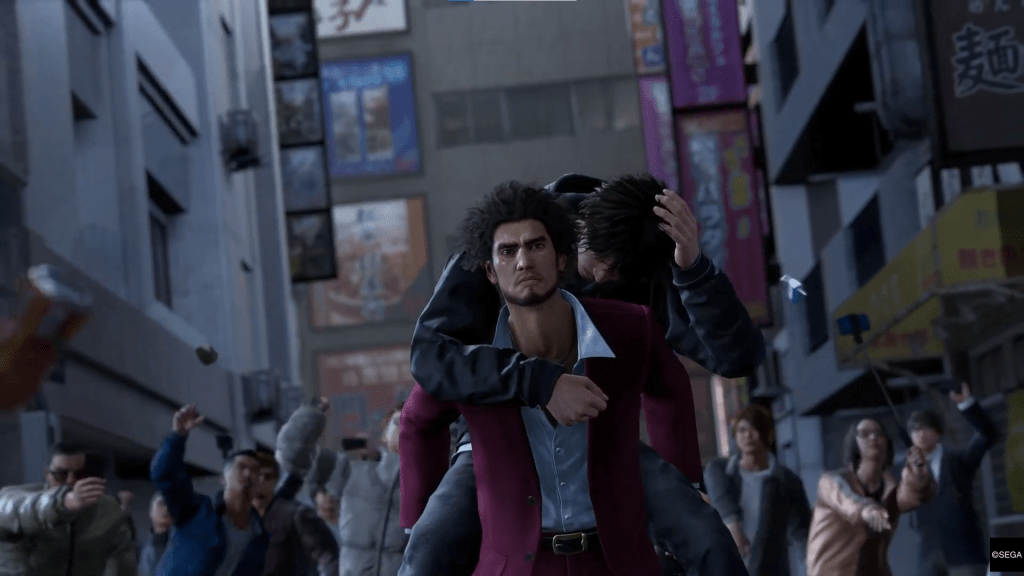
This mirroring doesn’t suddenly made LaD a Christian game for religious types, not at all the angle I’m going for. But what it does is bring the raw emotion and sacrifice of that story into a modern, different setting.
The physical nature of the act, the journey Ichiban takes and the fact he is so beaten and bloody by the end (alongside all the other hints at the Yakuza’s “Sin” throughout the game) all compound to create a modern Road to Calvary that will hit you hard no matter if you know the inspiration or not.
Ichiban is even stopped halfway by a particularly rowdy bunch from earlier in the game, eager to take the chance to show up public enemy #1 on camera. So they stop Ichi, and begin throwing punches.
But Ichi doesn’t.
Ichi knows that this walk, the weight of Eiji, and the wounds from these punches are all one and the same. They are all just consequences on the pile that he, as the redeemer of the Yakuza, is going to have to face.
He delivers Eiji to Tokyo PD, and stretches his arms.
He is hit by a stray bottle, and falls down, presumably unconscious.
With that, we see that Ichi will do anything to make sure that everyone, no matter how lost, is found. All lights turned off, can be turned on.
The Best Part of the Ending – The Achievement Name
Finally, during the credits, we see Kiryu registered at a hospital. Not as Joryu, or Taichi Suzuki, but as Kiryu Kazama. The achievement / trophy pops up, and is simply named:
“The Man Who Reclaimed His Name”
It’s a shame they hid such a powerful final line in an achievement / trophy name, as it truly wraps up the entire Kiryu side of the story perfectly.
Not only is it important following his revelation on Tatara Channel and more, so now he can freely see Haruka and Haruto, but it also shows his own coming-to-terms with who he is.
He is Kiryu Kazama, Ex-Tojo Chairman and he cannot hide from the fact he is the cause of much of this “sin”.
While he was “Dead”, he was so determined that a dead man has no stake in the world, has no will of his own. But now he realises that the real thing, a real death, is vastly different to that, is more than that.
And he wasn’t going to face that as Joryu or Suzuki, he was going to face that as Kiryu.
A Satisfying Ending for Newer Players
All of the thought and symbolism that goes into Infinite Wealth does elevate the ending, but it still lacks the same punch and adrenaline as previous titles. Even when the games end on a bittersweet note, or straight up depressing one (See: Yakuza 7), they tend to focus on storytelling and progression of events rather than symbols and analogy.
The other reason that all Kiryu endings in all games since 5 feel awful is that Kiryu could easily have died in 5, and created a timeline where Yakuza naturally becomes something new rather than clinging on to the poor guy and de-aging everyone.
It feels a little unfair to have all the old crew from games 1 – 5 back in Infinite Wealth, only to use them for a couple gimmick boss fights and not explore the real story implications.
For people who started with Yakuza 7, Infinite Wealth is pretty much perfect. The ending won’t feel like it’s missing anything because they quite literally don’t know what they are missing. But, for players who have played through the entire series (Including Yakuza 3, you weirdos who skip it)Infinite Wealth can feel like half of an ending.
If only we had it end with 56 minutes of cutscenes instead of 30, it may well have been the best one yet.



 Frame Imperfect | Gaming
Leave a comment